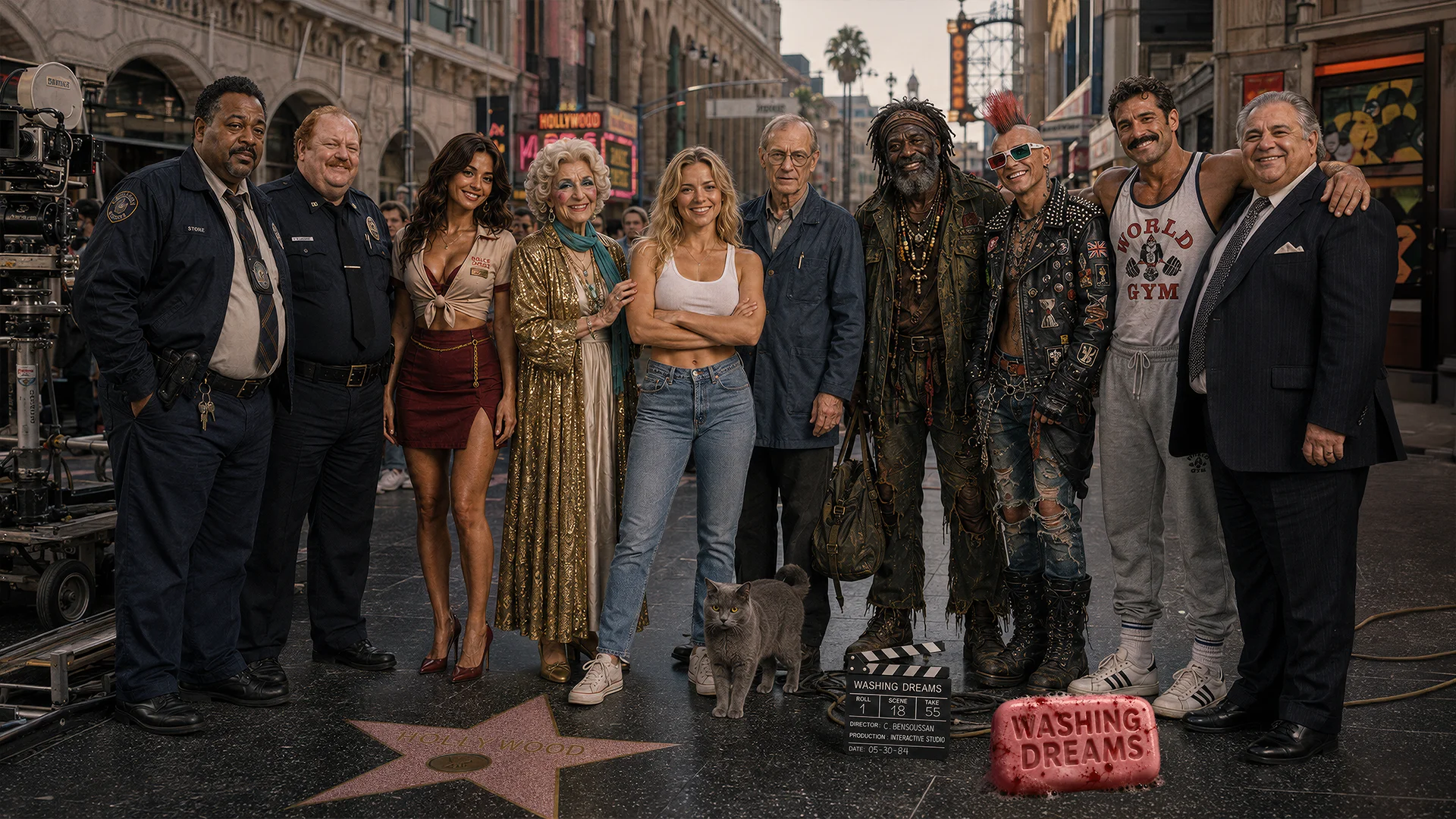
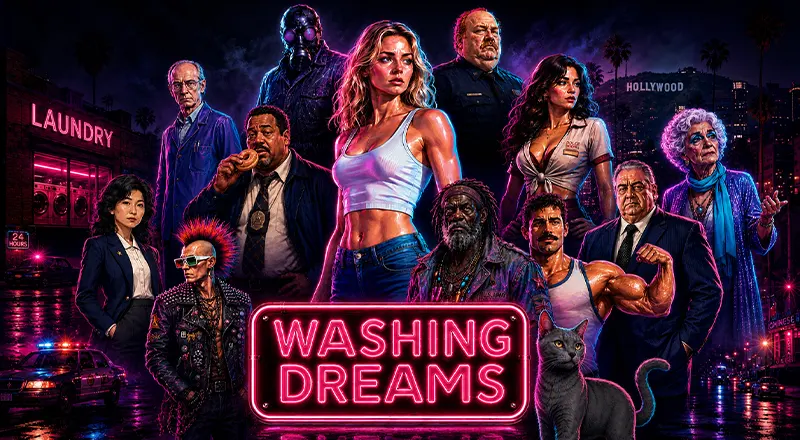
Hollywood, 1984. A laundromat open late at night. Dreams of fame, lost souls, and several young women who mysteriously disappear.
With Washing Dreams, Interactive Studio is developing an original cinematic project at the crossroads of thriller, film noir, and AI-assisted creative experimentation.
Designed from the outset as a complete narrative universe, Washing Dreams is more than a technological showcase. The project explores a new way of imagining, producing, and developing audiovisual fiction by combining human writing, art direction, staging, editing, music, and artificial intelligence tools.
Discover the first trailer for Washing Dreams!
A Thriller Set in 1984 Hollywood
Washing Dreams takes us back to Hollywood in the mid-1980s, a time when thousands of young performers arrived in California every year hoping to become famous.
Behind the neon lights, limousines, and promises of success lies a darker reality. The city creates stars, but it also abandons those who never make it into the spotlight.
In a world where everyone is playing a part, several young women disappear without a trace. The danger is present, but difficult to identify. Appearances are deceptive, the list of suspects keeps growing, and every character seems to be hiding part of their story.
The project draws on the codes of the whodunit, the psychological thriller, and film noir, without relying on the supernatural. Viewers are invited to study the details, compare testimonies, and uncover what may be hidden behind the laundromat machines.
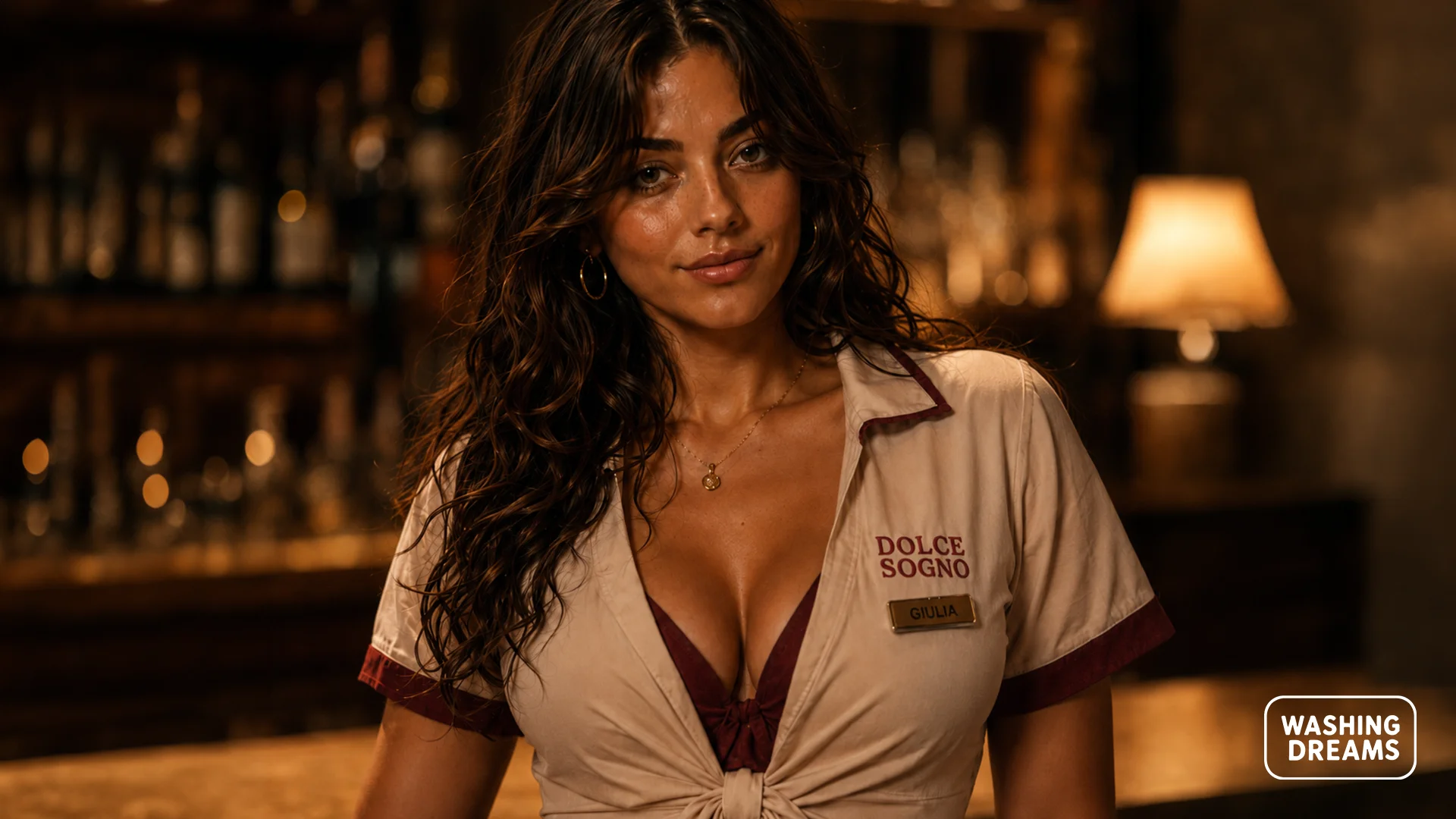
Giulia, a waitress at Dolce Sogno, clings to her dreams while simply trying to make ends meet.
The Laundromat as a Refuge for Tired Souls
At the heart of the story is a neighborhood laundromat.
An ordinary, impersonal, almost invisible place where people meet who would probably never have crossed paths anywhere else.
Aspiring actors, former celebrities, night workers, police officers, outsiders, tourists, and local residents come to wash their clothes, wait for a cycle to end, and forget, for a few minutes, whatever is burning inside them.
The laundromat becomes a refuge, a confessional, and a miniature theatre. Everyone arrives with dirty laundry, but also with secrets, regrets, and damaged dreams.
The title Washing Dreams carries this double meaning: washing clothes, while also trying to cleanse mistakes, disappointments, or sins.
And among all the machines, one seems to play a particularly important role: the mysterious machine number 14, officially marked out of order.
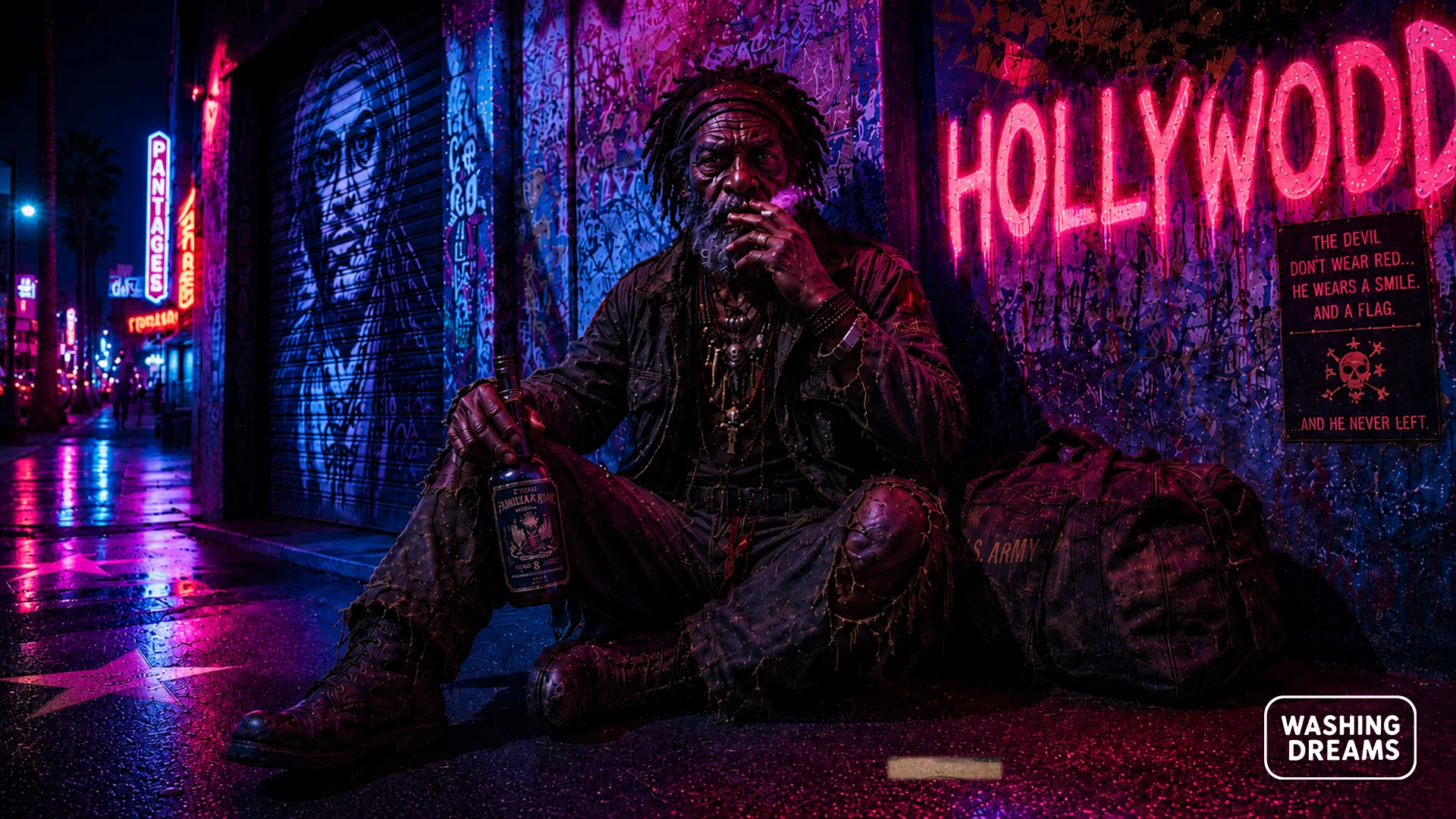
A veteran scarred by life, Marvin observes the world with a lucidity that few people understand.
A Universe Built Around Singular Characters
The identity of Washing Dreams is largely shaped by its gallery of characters.
Carla Marlow dreams of becoming an actress and earns a living as a Marilyn Monroe impersonator. Giulia Rossi works as a waitress before mysteriously disappearing. Michael Stone is trying to connect several cases that no one else seems willing to link. Gloria Bernstein, a 90-year-old former actress, observes modern Hollywood with sharp lucidity. Marvin Beauregard, a Vietnam veteran, appears to sense what others would rather ignore.
Around them are police officers, performers, laundromat regulars, and more ambiguous figures.
Each character has a personal history, a distinctive visual identity, specific costumes, meaningful props, and their own way of inhabiting 1984 Hollywood. The goal is to build a universe rich enough for every protagonist to become a clue, a witness, a suspect, or the central figure of a parallel story.
Even Luxy, the laundromat cat, has a special place within this strange microcosm.
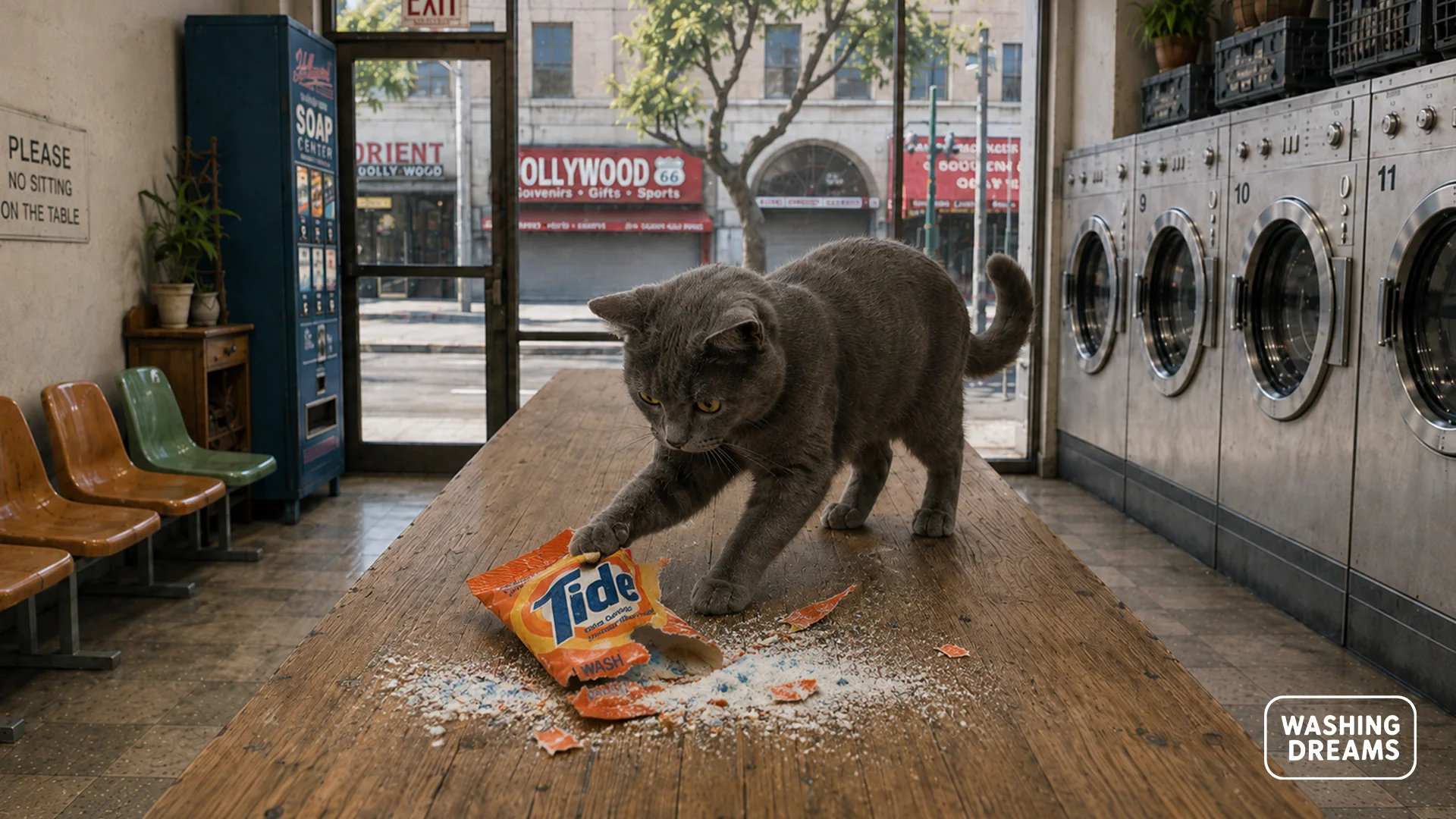
The little queen of the laundromat, Luxy comes and goes freely as if the whole place belonged to her.
An AI-Native Work, Yet Deeply Human
Washing Dreams was conceived as an AI-native cinematic project. Artificial intelligence is involved from the earliest stages of development and supports the production process throughout.
It is used to develop characters, explore visual directions, create environments, produce certain sequences, design camera movements, and rapidly test different staging ideas.
However, Washing Dreams is not a film automatically generated by a machine.
Every image is guided by human intention: a choice of framing, lighting, costume, expression, rhythm, or storytelling. The sequences are written, directed, selected, edited, refined, and sound-designed in order to maintain cinematic coherence.
Artificial intelligence does not replace creativity. It becomes a new production tool, comparable to the arrival of digital effects, 3D, or compositing in the history of cinema.
Above all, it allows a small creative team to build an ambitious universe with a level of visual freedom that was previously reserved for productions with far larger budgets.
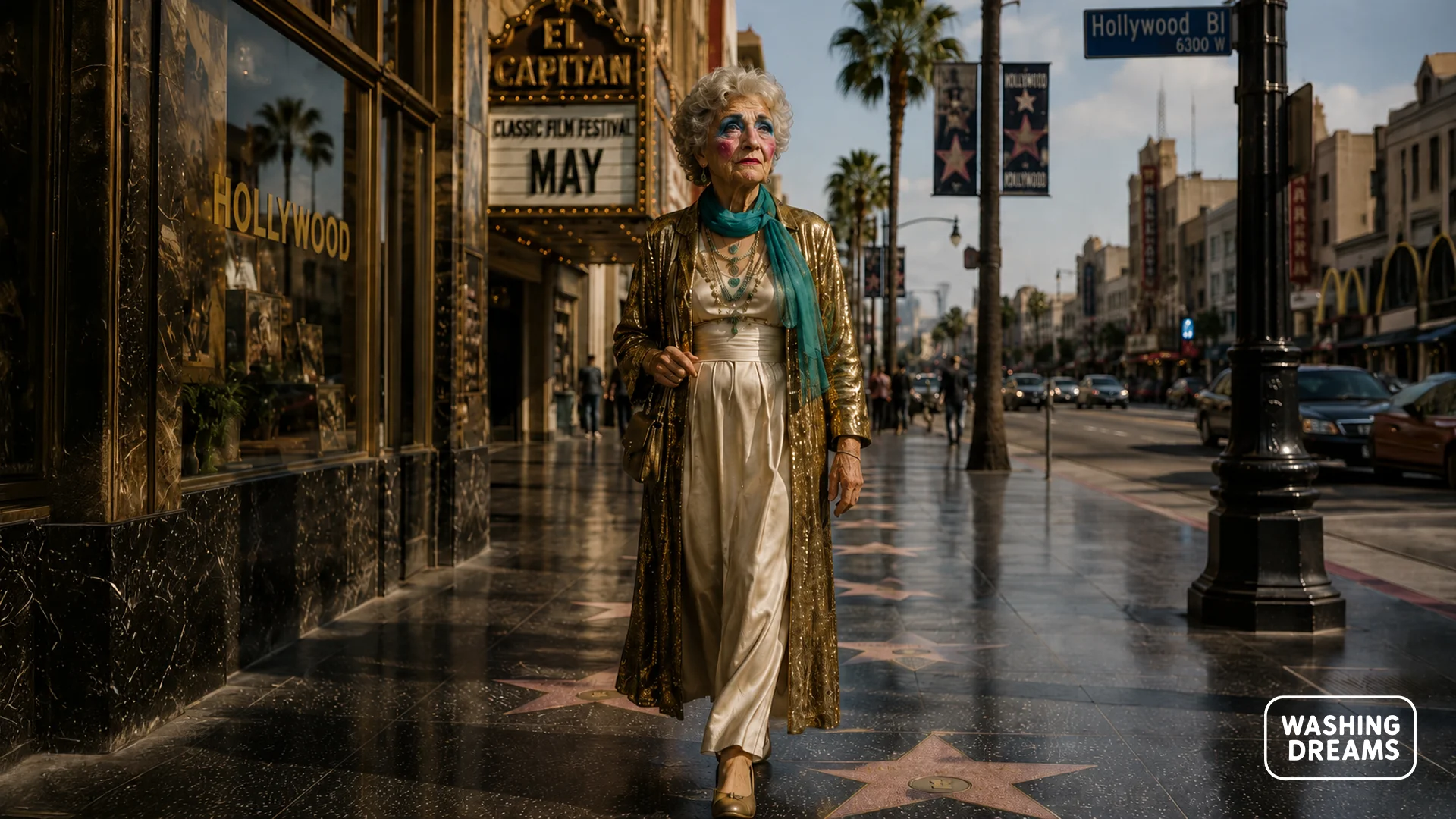
A former actress, Gloria carries within her the memories of a Hollywood that no one knows anymore.
Recreating Hollywood Without Simply Imitating the Past
One of the project’s main artistic challenges was to recreate the atmosphere of Los Angeles in 1984 without relying on a simple accumulation of nostalgic references.
The visual world combines neon signs, motels, bars, gyms, American cars, CRT televisions, and the façades of Hollywood Boulevard. However, each of these elements must serve the story.
The exterior lighting is often warm, while the laundromat interiors are colder and more clinical. The colour palette evokes 1980s thrillers, while some compositions reference film noir and the illustrated movie posters of the period.
The art direction also extends to the project’s graphic identity: a retro logo, title sequences, character portraits, posters, music covers, and social media content.
The overall aim is to create the feeling that Washing Dreams could have been discovered on a forgotten VHS tape forty years later.
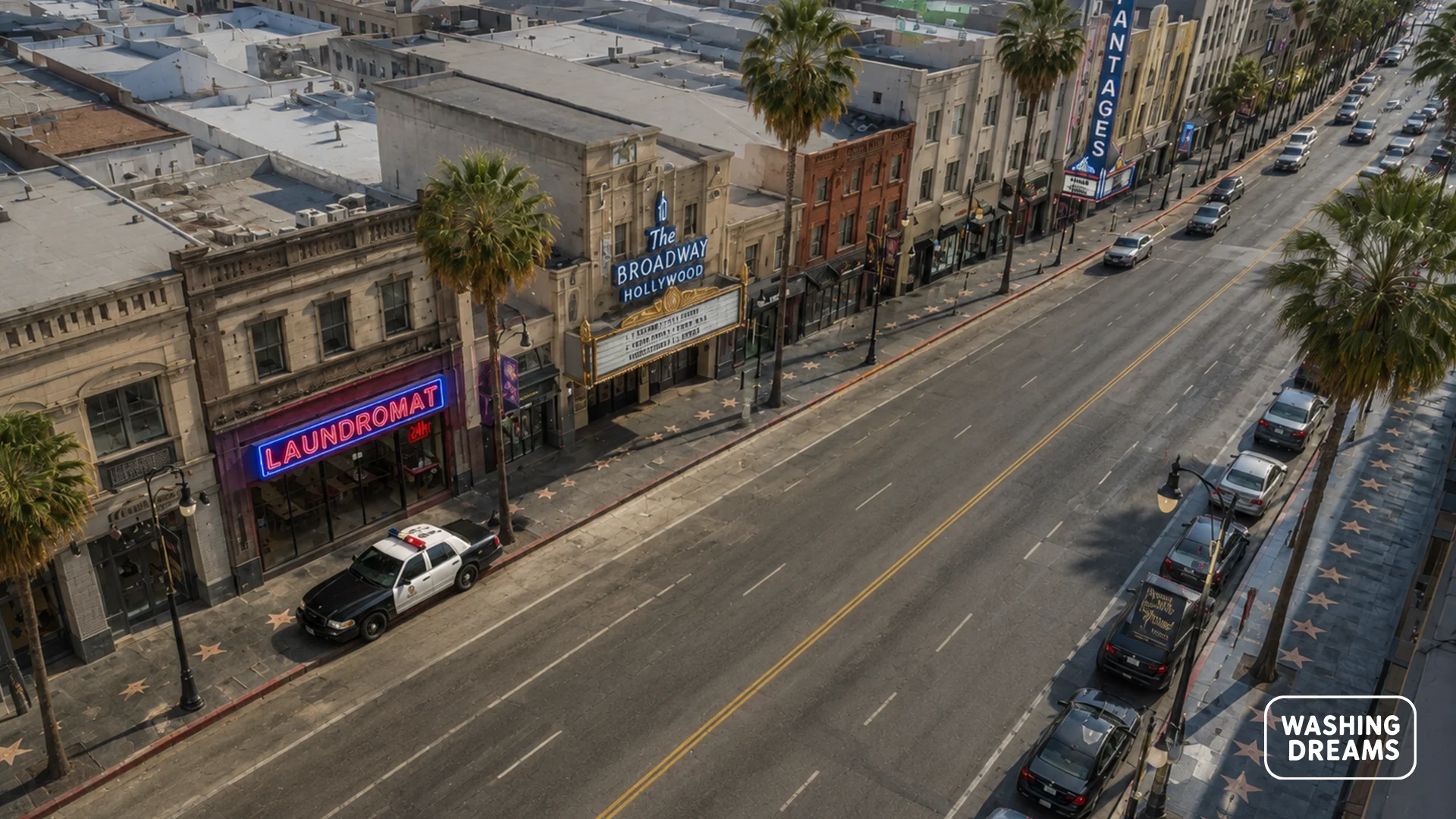
Aerial view of the laundromat from the film Washing Dreams in Hollywood, 1984
An Original Soundtrack Created for the Project
Music also plays an essential role in the identity of Washing Dreams.
An original song was developed around the film’s central themes: the fascination with Hollywood, the pursuit of fame, broken dreams, and the people who disappear behind the spotlights.
Positioned between dark pop and thriller music, the song allows the universe to exist beyond the film itself. A karaoke version, inspired by 1980s singing machines and popular culture, also extends the world of the project.
Voices, music, sound effects, sound design, and silence all contribute to the tension of the story. Sound can transform very simple elements—the rotation of a washing machine drum, the buzzing of a neon light, or a coin falling into a machine, into genuine narrative signals.
A Production by Interactive Studio
Washing Dreams is produced by Interactive Studio as part of its ongoing exploration of new forms of audiovisual storytelling.
The core creative team includes:
The production combines several creative tools, including Runway, Seedance, After Effects, ElevenLabs, Suno, Photoshop, Claude, and ChatGPT.
Each tool plays a specific role within the process, but the real challenge lies in the artistic coordination of the whole: maintaining consistent characters, locations, historical details, and narrative tension from one sequence to the next.
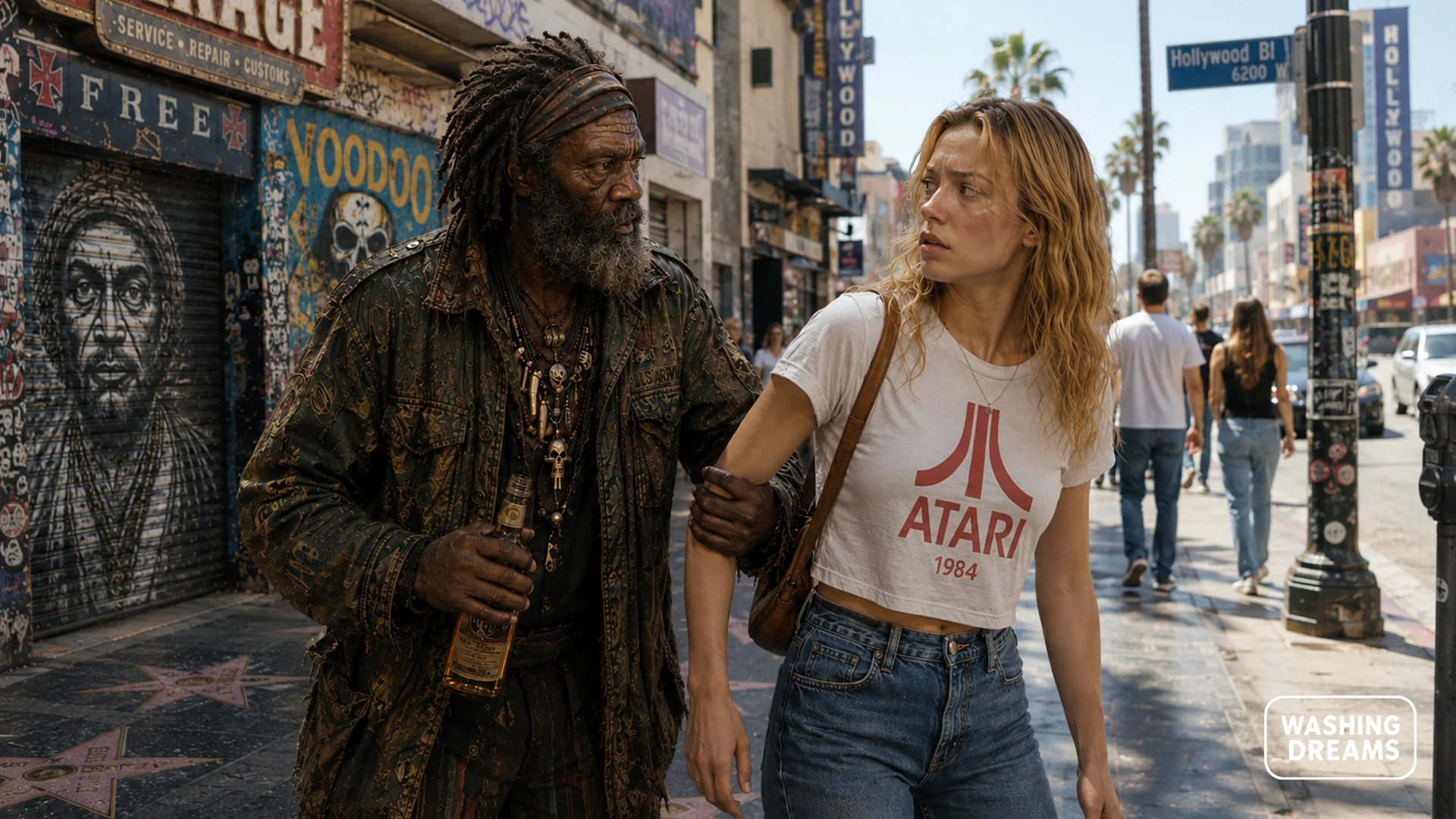
What does Marvin have that’s so important to say to Carla?
More Than a Film: The Birth of a New Universe
Washing Dreams was designed as an intellectual property capable of expanding across multiple formats.
The first episode serves as the entry point into this world, but the story could later continue through new episodes, character-focused content, music videos, immersive experiences, or interactive formats.
The goal is also to demonstrate how artificial intelligence can support the creation of a genuine fictional universe, complete with recurring characters, iconic locations, a visual identity, and its own mythology.
The project is intended for release on YouTube, as well as presentation at festivals dedicated to cinema and artificial intelligence, and at professional events focused on visual creation, storytelling, and emerging technologies.
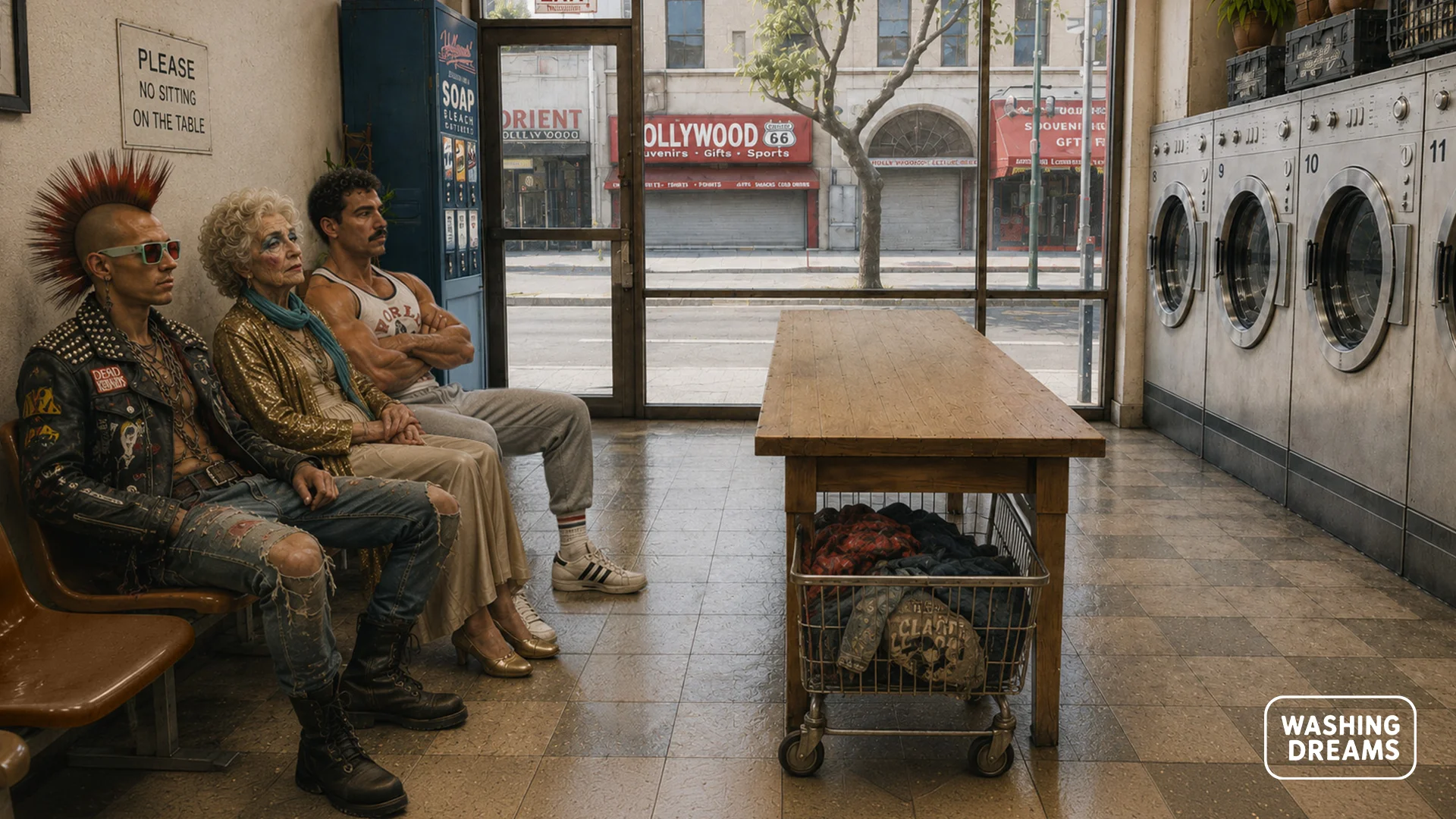
Peter, Gloria and Tom are patiently waiting for their laundry… or something else?
The First Episode Is Entering Its Final Stage
After several months of writing, character development, art direction, and sequence production, the first episode of Washing Dreams is entering its final stage.
A 45-second trailer already offers a first glimpse into the atmosphere of the project: a fascinating yet unsettling Hollywood, a laundromat filled with tired souls, and the persistent feeling that something is hiding behind the surface.
With Washing Dreams, Interactive Studio aims to demonstrate that a new generation of films is beginning to emerge.
Films in which artificial intelligence does not replace ideas, artists, or direction, but expands what a creative team is able to imagine and produce.
Welcome to Hollywood.
Welcome to the laundromat.
Welcome to Washing Dreams.
Do you have questions about Artificial Intelligence?